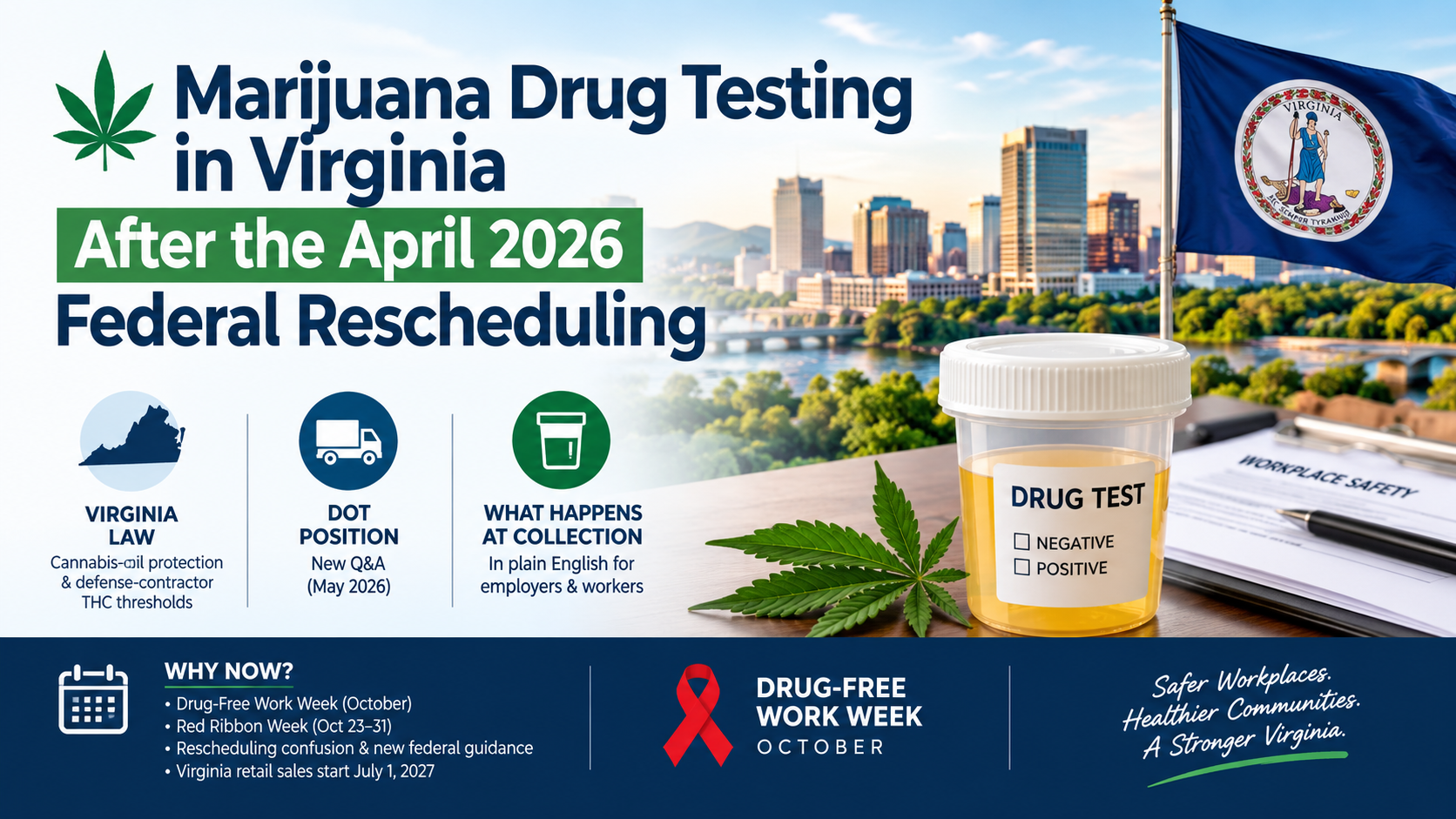
If you run a crew, manage a fleet, or just got a job offer that says "pending drug screen," you've probably heard marijuana was "rescheduled" this year. Some people took that to mean THC no longer shows up on a work drug test, or no longer matters if it does. Neither is true. Marijuana drug testing in Virginia looks almost the same as it did a year ago, with a few new wrinkles worth understanding.
Since October brings Drug-Free Work Week, here's a plain-English rundown from the occupational health team at Altmed Medical Center in Manassas: what changed, what didn't, and what to expect at your collection visit.
Quick answer
- The April 2026 federal order moved only FDA-approved marijuana products and state-licensed medical marijuana to Schedule III. Everything else is still Schedule I.
- DOT-regulated drivers and other safety-sensitive workers are still tested for marijuana, and a state medical card doesn't excuse a positive.
- Virginia protects certain medical cannabis oil users from discipline, with exceptions for impairment at work, federal requirements, and defense contractors.
- Private employers in Virginia can still keep THC on their panels.
- A positive THC test shows past use. It doesn't measure impairment.
What actually changed with marijuana rescheduling in 2026?
Less than the headlines suggested. On April 22, 2026, the Justice Department placed two narrow categories into Schedule III of the Controlled Substances Act: FDA-approved drug products containing marijuana, and marijuana covered by a state medical marijuana license. All other marijuana stays in Schedule I.
The bigger question, whether to move all marijuana to Schedule III, went to a DEA hearing that ran from late June to mid-July. It didn't settle anything. In early October the judge overseeing it temporarily paused the case while the parties argue over adding a new government report to the record.
Rescheduling also isn't legalization. Schedule III drugs still need a prescription, and recreational marijuana remains illegal under federal law.
Do DOT drivers still get tested for marijuana?
Yes. The Department of Transportation's drug and alcohol office said in December 2025 that its testing rules wouldn't change during rescheduling. In a May 15, 2026 Q&A it went further: a state medical marijuana card is not a legitimate medical explanation for a positive result, and Medical Review Officers (MROs) must still verify a lab-confirmed THC positive as positive.
That applies to truck and school bus drivers, transit operators, pilots, pipeline emergency responders, and other safety-sensitive roles. A verified positive takes the employee off safety-sensitive duty until they finish the return-to-duty process with a Substance Abuse Professional.
CBD is the quiet trap. DOT tests for marijuana, not CBD, but CBD labels aren't federally verified and some products carry more THC than they list. DOT has said plainly that "I only used CBD" won't change a confirmed result. If you hold a CDL, talk with a provider before trying any CBD product. Drivers coming up on a medical card renewal can see what to bring on our DOT physical page.
Does Virginia law protect employees who use medical cannabis?
Partly. Under Virginia Code § 40.1-27.4, an employer can't fire, discipline, or discriminate against an employee for lawful use of cannabis oil under a valid written certification from a practitioner.
The same section lists what it doesn't do. Employers can still act on impairment at work and can ban possession during work hours. Nothing in it requires an employer to break federal law or put a federal contract or funding at risk. And defense industrial base employers don't have to hire or keep someone who tests above 50 ng/ml of THC in urine or 10 pg/mg in hair.
That last detail matters more around here than in most of the state, since plenty of Prince William County employers do federal or defense work. Keep in mind, too, that a lab test can't tell cannabis oil apart from other cannabis products.
Because this sits where health and employment law meet, the employer's HR lead or attorney should decide how a policy applies to a specific person. Our part is the collection and the process, not the legal call.
Can employers still test for marijuana if adults can legally possess it?
Generally, yes. Adults 21 and older have been allowed to possess marijuana in Virginia since 2021, but that law created no job protections for recreational use, so employers can keep THC on their test panels.
What's new is a retail market. Budget legislation enacted in June 2026 allows up to 350 licensed cannabis stores to start selling to adults 21 and older on July 1, 2027. If your company's drug policy hasn't been reviewed in a few years, you have about eight months before legal storefronts open.
Why do urine, saliva, and hair tests give such different results?
Each specimen looks back over a different window, and the gap is wide. In the 2026 Quest Diagnostics Drug Testing Index, which covers 2025 results, marijuana positivity in the general U.S. workforce was 4.4% in urine, 11.1% in oral fluid, and 15.1% in hair. Overall urine positivity has stayed above 4% for more than a decade.
A rough guide to the three:
- Oral fluid usually reflects recent use, and the collection is directly observed.
- Urine covers a wider window and is still the standard for DOT testing.
- Hair can reach back about 90 days, which is why some employers use it before hiring.
None of these measures impairment. THC metabolites can linger long after any effect has worn off, so reasonable-suspicion decisions should rest on documented, observed behavior, with the test as one part of the record. Not sure which specimen fits a role? Our drug and alcohol testing page walks through each option, from 5-panel and 12-panel urine screens to breath alcohol testing.
What should Manassas employers review during Drug-Free Work Week?
Drug-Free Work Week is an annual October campaign promoted by the National Drug-Free Workplace Alliance, and it's a good excuse to pull out the policy binder. A short checklist:
- Separate DOT and non-DOT employees in writing. Federal rules govern one group; your company policy governs the other.
- Decide what a medical cannabis disclosure triggers. Who reviews it, and how, with legal input.
- Train supervisors on reasonable suspicion. Observed, written-down behavior, not hunches.
- Confirm your post-accident protocol. Who brings the employee in, and what paperwork comes along.
- Check your MRO and TPA setup. Results should reach the right person, and random pools should meet current DOT rates.
- Point people toward help. An EAP, a primary care visit, or the free, confidential SAMHSA National Helpline at 1-800-662-4357, open 24/7.
AltMed coordinates MRO services and works with third-party administrators, so a local employer can keep collections, result review, and random-pool administration in one place.
What happens when you come to Altmed for a drug test?
Most collections take a few minutes. Bring a photo ID and whatever your employer sent you, such as a chain-of-custody form, requisition, or authorization letter. Testing for a personal or court requirement instead? Tell the front desk so staff can confirm the right process.
Rapid screens can often be read the same day. Lab-confirmed tests and anything needing MRO review take longer, depending on the program and panel. Staff follow chain-of-custody procedures for both DOT and non-DOT collections, and results go only to the people your program designates.
We're at 8551 Rixlew Lane, Suite 140 A, open Monday through Friday, 9 AM to 5 PM, and walk-ins are welcome for many services. Employers who want an account for recurring testing can reach our team or browse our occupational health services.
Care connected to this topic
Altmed Medical Center offers urgent care, primary care, occupational health, telehealth, and medical weight-loss services in Manassas. If this article matches what you are dealing with, our team can help you choose the right service.
Book Appointment