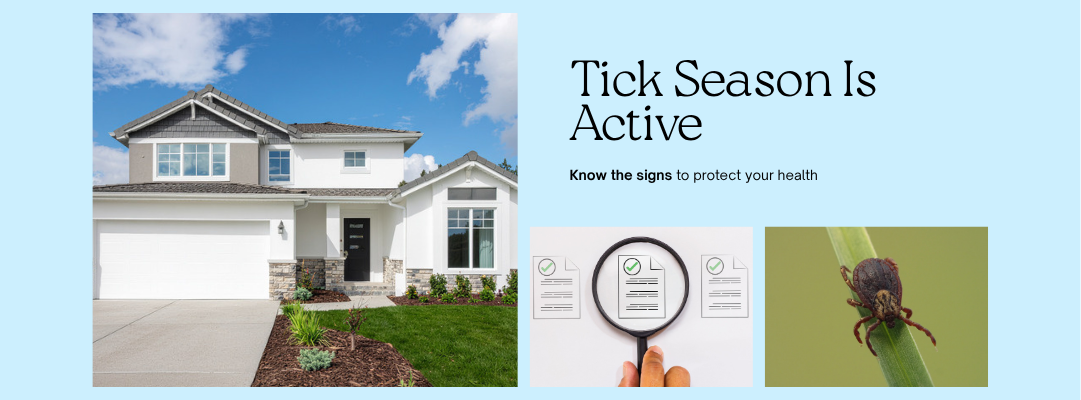
If you've spent any time in a backyard, on a trail, or at a ball field around Manassas this summer, you've probably pulled a tick off yourself or your kid at least once. That's not just a local impression. Federal health data this season show emergency room visits for tick bites running at their highest rate in almost a decade, and Virginia is one of the states seeing the most activity. For a community like ours, where wooded parks, trails, and backyards butt right up against neighborhoods, that's worth paying attention to.
Here's what's actually going on, what symptoms deserve a same-day visit, and where a walk-in clinic fits into the picture.
Why this tick season looks different
A few things are lining up at once. Winters have been milder, which lets more ticks survive year to year. Deer populations, a key host for adult ticks, have grown in many areas. And as neighborhoods expand closer to wooded and brushy land, people simply cross paths with ticks more often than they used to. None of that is unique to Manassas, but Prince William County has plenty of the tree lines, trails, and yard edges where ticks wait for a host to brush past.
The tick species most relevant here are the blacklegged (deer) tick, which can carry Lyme disease, and the lone star tick, which is linked to a red meat allergy called alpha-gal syndrome. Both are established in Virginia.
Symptoms that mean it's time to get checked
Most tick bites don't lead to illness. But it's worth knowing what to watch for in the days and weeks after one:
- A rash at the bite site, especially one that expands outward, with or without the classic bull's-eye look. Not everyone with Lyme disease gets a rash, so don't wait for one before taking other symptoms seriously.
- Fever, chills, headache, fatigue, or muscle and joint aches that show up days to weeks after being outdoors in tick habitat.
- Swollen lymph nodes.
- Hives, stomach upset, or a delayed allergic reaction (often two to six hours) after eating red meat or dairy, which can point to alpha-gal syndrome rather than Lyme disease.
Any of these after a known or possible tick exposure is a reasonable reason to come in and get evaluated, even if you never saw or removed a tick.
What to do right after a bite
- Remove an attached tick as soon as you find it. Use fine-tipped tweezers, grasp it close to the skin, and pull straight up with steady pressure. Don't twist, and don't use petroleum jelly, nail polish, or a hot match to try to make it detach.
- Clean the bite area and your hands with soap and water or rubbing alcohol.
- Note the date and, if you can, save the tick in a sealed bag or take a photo. It can help a provider narrow down what to watch for.
- Removing a tick within 24 hours meaningfully lowers the chance it transmits Lyme disease, so don't wait until your next scheduled appointment if you can pull it out now.
When to go to urgent care instead of waiting it out
A walk-in visit makes sense if you have a new or spreading rash, fever, joint pain, flu-like symptoms after time outdoors, or a tick that's been attached for a while and you're not confident it came out in one piece. Early Lyme disease is generally treated with a short course of antibiotics, and starting that early tends to make the whole thing simpler.
When it's an emergency, not a walk-in visit
Some reactions need immediate emergency care, not a clinic appointment. Call 911 or go to the nearest ER for:
- Sudden difficulty breathing, throat tightness, or swelling of the face or lips
- A severe drop in blood pressure, fainting, or feeling like you're about to pass out
- Facial drooping or new weakness on one side of the body
- Any signs of a severe allergic reaction (anaphylaxis), including after eating red meat or dairy if you've had tick exposure
These symptoms are not something to monitor at home or schedule around.
What to expect at Altmed
At Altmed Medical Center, you can walk in without an appointment for a tick bite evaluation, a possible Lyme disease workup, or general tick-related concerns. A provider will look at the bite site, ask about your symptoms and where you were likely exposed, and talk through whether testing or treatment makes sense for your situation. We also see patients for the after-the-fact stuff, a rash that popped up a week after a hike, or joint pain that started a few weeks after a camping trip. Same-day appointments and walk-ins are both available, and most major insurance plans are accepted.
If you're dealing with a possible allergic reaction or other urgent symptoms, our urgent care team can see you the same day; for ongoing symptoms or follow-up, our primary care providers can help too. You can also make an appointment online or get directions and contact info.
Care connected to this topic
Altmed Medical Center offers urgent care, primary care, occupational health, telehealth, and medical weight-loss services in Manassas. If this article matches what you are dealing with, our team can help you choose the right service.
Book Appointment