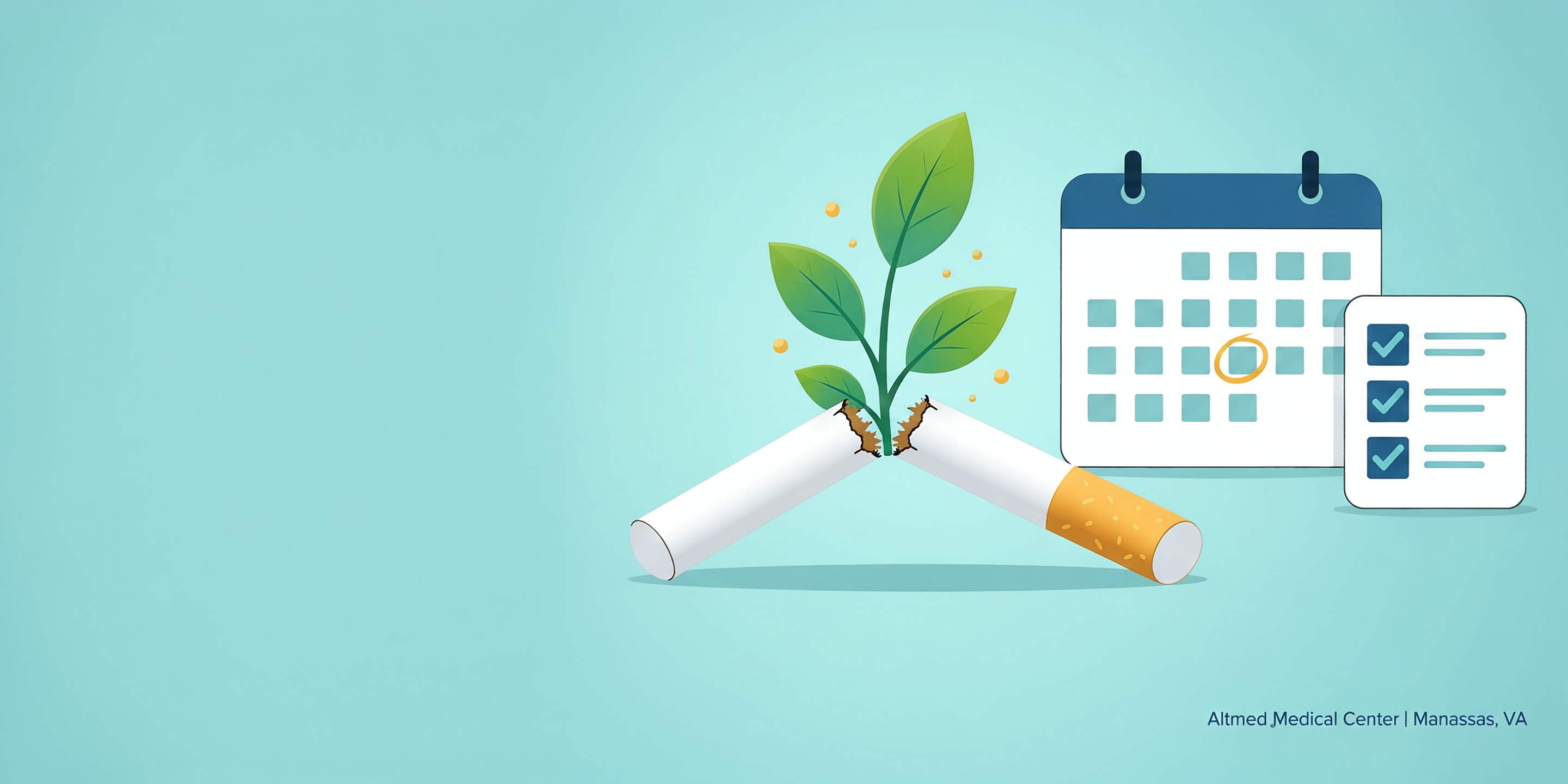
This Thursday, November 19, is the American Cancer Society's Great American Smokeout. It's the 50th one. The idea is the same as it was in 1976: pick one day to stop, and treat it as day one rather than a test you have to pass forever.
If you've been meaning to quit smoking in Manassas, VA, or anywhere in Prince William County, you have two days to get ready. That's enough time to set things up so Thursday goes better than your last attempt.
The short version
- Pick Thursday, November 19, or another date in the next two weeks, as your quit day.
- Expect the first week to be the hardest. Withdrawal usually peaks in the first three days.
- Counseling plus medication can more than double your chances of quitting, according to the CDC.
- Virginia's quitline is free and open 24/7: call 1-800-QUIT-NOW or text READY to 34191.
- A primary care provider can help you pick a medication that fits your health history.
Why does picking a quit date help?
A date turns "I should quit" into a plan with a start line. Health department guidance for the Smokeout puts "set a quit date" first for a reason: naming the day makes you more likely to follow through.
The Smokeout just gives you a date that thousands of other people are using too. You don't have to use Thursday. If you have a work trip or a hard week coming, pick a calmer day soon after. What matters is that it's on the calendar.
What should you do in the 48 hours before you quit?
Use the time before Thursday to remove friction. A few things that tend to help:
- Tell two or three people. A coworker who'll skip the smoke break with you counts.
- Get rid of cigarettes, vape pods, lighters and ashtrays from your car, desk and coat pockets.
- Write down your three biggest triggers. For a lot of people it's the first coffee, the drive in on Route 28 or I-66, and the end of a shift.
- Plan a swap for each one: gum in the car, a short walk after lunch, water instead of the second coffee.
- Decide on medication now, not in the middle of a craving. More on that below.
- Save the quitline number in your phone.
What will the first week feel like?
Rough, then better. The National Cancer Institute says withdrawal symptoms are usually worst during the first week and peak in the first three days, then ease over the following month.
Common symptoms include strong cravings, irritability, restlessness, trouble sleeping, trouble concentrating and a bigger appetite. Smokefree.gov notes that the first week is when you're most likely to slip and smoke, which is why planning matters more than willpower.
It helps to know that withdrawal is uncomfortable but not dangerous. Cravings come in waves. If you can ride out one wave with a walk, a glass of cold water or a phone call, the next one is often a little weaker. After about two weeks, many people find the physical symptoms have faded and the urges come further apart.
Do quit-smoking medications actually help?
Yes, for many people. The CDC lists seven FDA-approved quit medications. Five are forms of nicotine replacement: the patch, gum, lozenge, inhaler and nasal spray. The other two, bupropion and varenicline, are prescription pills that don't contain nicotine.
The CDC also says counseling and medication each work on their own, but together they can more than double your odds of quitting. Pairing a long-acting patch with a short-acting option like gum or a lozenge also improves your chances.
Here's the gap: according to the 2020 Surgeon General's report, fewer than one in three adults who try to quit use counseling or an FDA-approved medication. Most people go it alone.
Some nicotine replacement products are sold over the counter, but it's still worth a conversation with a provider if you have heart disease, are pregnant or breastfeeding, take other medicines, or have tried before without success. Prescription options need a provider anyway. If you don't have a regular doctor, our primary care team in Manassas can go over which option makes sense for you.
Is quitting vaping any different?
Not as much as people expect. Nicotine is nicotine, so withdrawal from vaping feels similar: cravings, irritability, poor sleep. The same planning steps apply, and Quit Now Virginia supports people who vape as well as people who smoke.
One thing to know: e-cigarettes aren't FDA-approved quit aids. The CDC says that if adults who smoke switch to e-cigarettes, they'd need to stop cigarettes completely to get any real health benefit. Using both doesn't count as quitting.
Where can you get free help in Virginia?
Start with Quit Now Virginia, run by the Virginia Department of Health. It's free, confidential and open 24 hours a day:
- Call 1-800-QUIT-NOW (1-800-784-8669)
- Text READY to 34191
- Spanish: 1-855-DEJELO-YA (1-855-335-3569)
- Online: QuitNowVirginia.org
A Quit Coach helps you build a personal plan, and free quit medicines may be available. The service is open to Virginians 13 and older, with coaching in many languages.
Insurance may also cover quit counseling and medication. Coverage varies by plan, so check with your insurer. You can see which plans we work with on our insurance page.
How can a primary care visit help you quit?
A short conversation with a provider is one of the most useful tools you have, and it's often skipped. The Surgeon General's report found that more than 40% of adults who smoke don't get advice to quit from a health professional.
At Altmed Medical Center in Manassas, VA, a primary care visit about quitting usually covers your smoking or vaping history, what happened in past attempts, your other health conditions and medicines, and which quit medication, if any, fits. Your provider can also check things smoking affects, like blood pressure, and set up follow-up so you're not on your own in week two.
If coming in is hard to fit around work, ask whether a follow-up can happen through telehealth. Questions about hours or what to bring? Our contact page has the details.
When is it more than a craving?
Quitting is uncomfortable, but some symptoms aren't withdrawal and shouldn't wait for a clinic visit. Call 911 for chest pain or pressure, severe shortness of breath, or signs of a stroke such as face drooping, arm weakness or slurred speech.
If your mood drops sharply, or you have thoughts of hurting yourself, call or text 988 any time. Tell your provider about mood changes on any quit medication too. And if you're pregnant, talk with a provider before starting any quit medication, since the CDC notes the evidence in pregnancy is limited.
What if you slip?
Then you slip. One cigarette on day four doesn't erase days one through three. Figure out what triggered it, adjust the plan, and pick back up.
It might help to remember that more than three in five U.S. adults who ever smoked have quit. Many of them needed more than one try. Every attempt teaches you something about your own triggers.
Care connected to this topic
Altmed Medical Center offers urgent care, primary care, occupational health, telehealth, and medical weight-loss services in Manassas. If this article matches what you are dealing with, our team can help you choose the right service.
Book Appointment